


Why Trustworthy AI Copilots Need Better Enterprise Knowledge, Not Bigger Models

By Prashant Pawar, Head Data and Cloud CoE, Nihilent Limited
Why Trustworthy AI Copilots Need Better Enterprise Knowledge, Not Bigger Models
AI copilots promise to transform how knowledge workers access information, make decisions, and serve customers. Yet many enterprises discover a hard truth when the pilots move beyond email and slideware into safety manuals, design standards, or contract repositories: generic copilots struggle with complex documents.
Gartner’s 2024 CIO Generative AI Survey shows why leaders persist despite these growing pains. Ninety-five percent of CIOs believe generative AI has significant potential to improve their organizations, and 74 percent see productivity as its top business value driver. But the same survey highlights a widening execution gap between ambition and realized value. The bottleneck is not the model. It is the enterprise content it is asked to reason over.
In large organizations, the documents that matter most are dense, technical, and often tabular. Safety procedures, manufacturing standards, pricing schedules, and contracts combine text, tables, diagrams, and exceptions that evolved over years of projects and audits. These repositories are rarely curated for machine consumption. They are full of unstructured files, inconsistent naming conventions, obsolete versions, embedded images, and weak or missing metadata. When copilots are dropped into this environment, their answers quickly become unreliable, especially when users ask for precise feature comparisons or clause-level interpretations rather than high-level summaries.
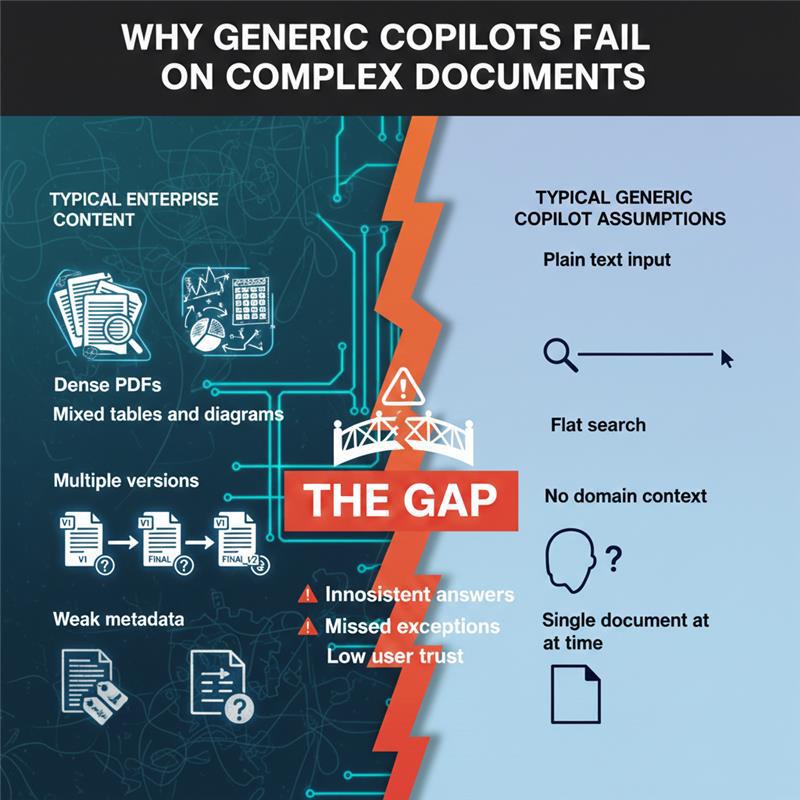
Forrester notes that as organizations move from prompt-based chat to agentic copilots, they encounter failure modes such as incomplete integrations and response misalignment that are much harder to diagnose than a single bad response. The lesson is clear: investing in copilots without investing in the underlying knowledge fabric only amplifies existing content and process weaknesses.
In our work, three design principles consistently separate successful copilots from the proof-of-concept graveyard.
First, content must be deliberately curated. Large, complex documents should be broken into meaningful sections, aligned with a clear hierarchy of standards, company policies, and local procedures, with versions and exceptions tagged explicitly.
Second, queries must be enriched with context. Rather than letting users type freeform prompts, the interface should guide them to specify persona, use case, and document scope, then use metadata to route retrieval to the right sources before the model generates an answer.
Third, the copilot must never be asked to “guess the business.” Domain specific terminology, product structures, and regulatory nuances have to be exposed through authoritative, well-governed content that the model can reliably ground itself in.
Gartner recommends that CIOs integrate generative AI into core areas only when they can align it with measurable outcomes and robust information governance, instead of treating copilots as generic productivity add-ons.
Many experts are converging on similar guidance. Forrester argues that making AI copilots successful “takes a village,” spanning data, process, and change management owners, rather than a single generative AI team.
The question is no longer “Do you have a copilot?” It is “Can you make copilots trustworthy on our hardest documents?” That requires a partner who can blend data strategy, knowledge engineering, and AI architecture into a coherent roadmap, not just wire up an off the shelf model. Enterprises that get this right will see copilots evolve from novelty chat interfaces into dependable collaborators for engineers, risk managers, and operations teams worldwide.
Valuable contributions from Ritesh Kumar Singh through Copilot implementations.
Most Read
May 28, 2019
Driving Operational Excellence Through Design Thinking
February 11, 2020
The Art of Data Science
June 12, 2019
Financial Inclusion through Digital Diversification