


Your ServiceNow Is Live. So, Why Is Nobody Using It?

By Sanjeev Singh, Vice President & Practice Head – ServiceNow, Salesforce and Testing, Nihilent Limited
Your ServiceNow Is Live. So, Why Is Nobody Using It?
The adoption gap that’s quietly killing your ROI
I’ve seen this play out more times than I’d like to count.
An enterprise spends months scoping, configuring, and deploying ServiceNow. The workflows are elegant. The integrations are solid. The go-live celebration happens. Then, six months later, the tickets are still flowing through email. The old spreadsheets are still open. The platform is live, but the transformation is not.
The platform did not fail. The change strategy did.
The Numbers Don’t Lie
It is not an isolated problem. It is an industry pattern backed by hard data.
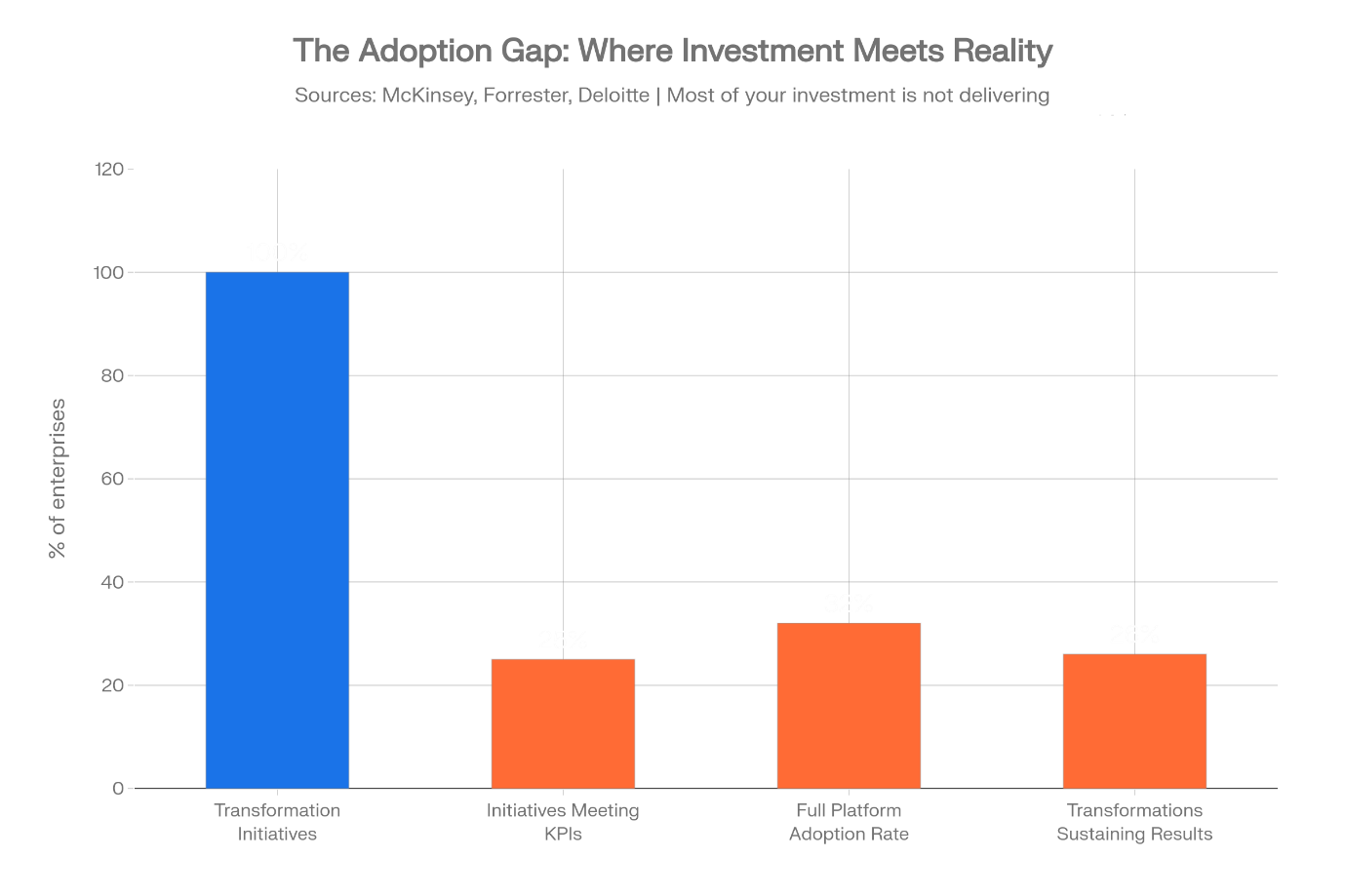
McKinsey research finds that 70% of digital transformations fail to achieve their business objectives, and only 26% of transformation efforts improve performance and sustain results long term. Gartner has projected that 60% of digital adoption initiatives will fail by 2028, not because of technology shortcomings, but because of underinvestment in learning and development. Forrester’s analysis shows that only 25% of transformation initiatives actually deliver their stated KPIs.
And here is the one that should stop every ServiceNow sponsor in their tracks: employee adoption rates across enterprise software implementations hover at just 32% (Deloitte, 2023). Meaning nearly 7 in 10 users are not fully adopting the platform their organization paid to deploy
The Real Problem Is Human, Not Technical
Randstad Digital’s research confirms that up to 50% of ServiceNow implementations underperform, and in most cases, the issues are not technical. They are strategic and operational. Users don’t resist ServiceNow because it is a bad platform. They resist it because that old, clunky system represents something they know. The new platform represents uncertainty, learning curves, and the fear of looking incompetent in front of colleagues.
According to Prosci’s benchmarking, 69% of workers described their most recent major change experience as negative. That carries over directly into platform adoption. And when users don’t adopt, the data quality inside ServiceNow degrades by 40 to 60% compared to organizations with strong adoption programs. You end up with a platform full of incomplete, inaccurate, or inconsistent records, which then undermines every reporting and decision-making use case you planned for.
What Mid-Sized Enterprises Are Getting Wrong
Large enterprises often have dedicated change management offices and transformation budgets. Mid-sized organizations rarely do. That creates a specific pattern of failure I see repeatedly:
-
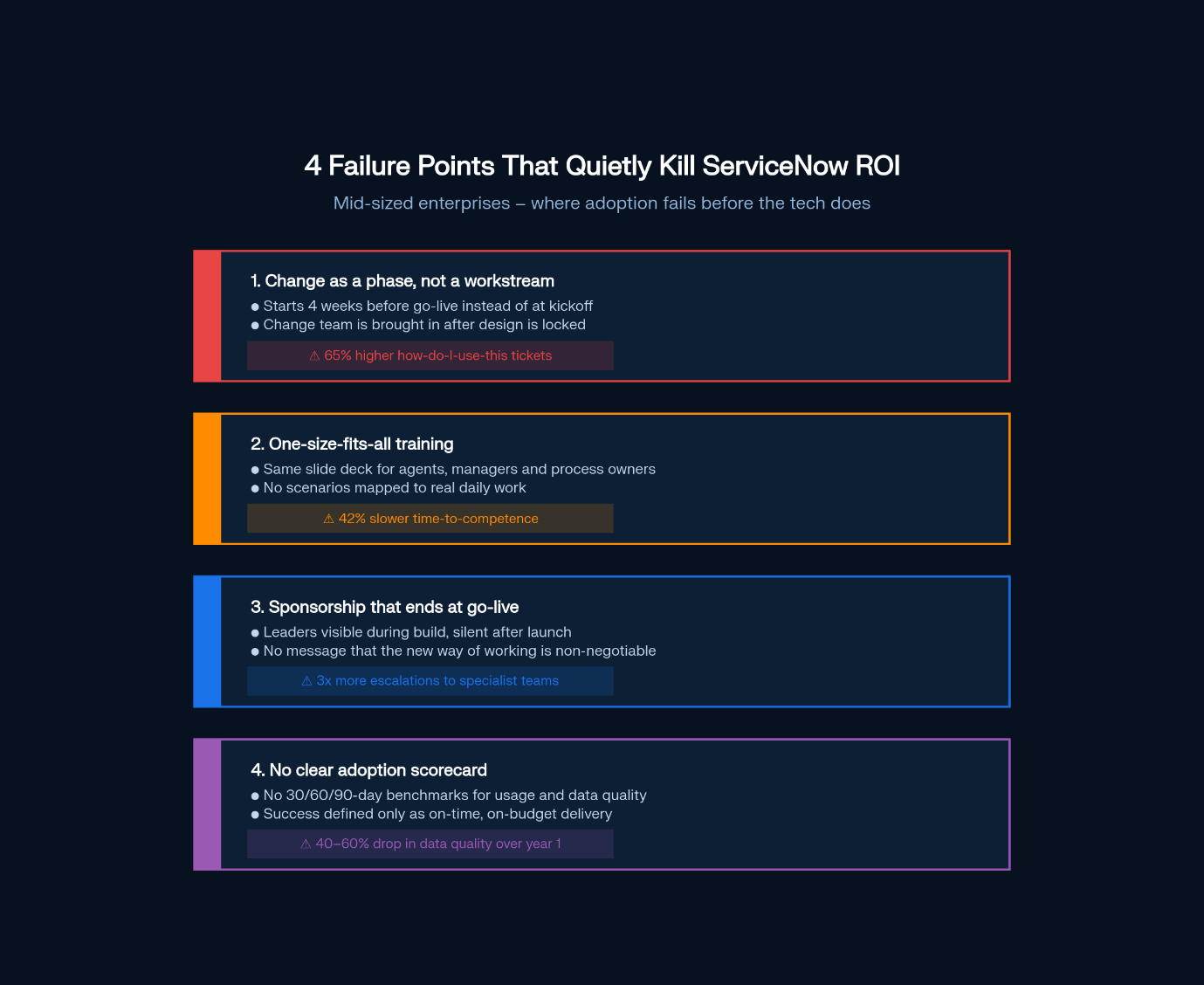
Change management is treated as a project phase, not a parallel workstream. It gets squeezed into the last four weeks before go-live, when it should start at the point of scoping.
-
Training is role-agnostic. A single walkthrough session for all users ignores the fact that a service desk agent, an IT manager, and a procurement lead have completely different workflows and different thresholds for adoption.
-
Executive sponsorship ends at go-live. Organizations with poor adoption rates experience 65% higher ticket volumes related to platform usage questions, 40% longer resolution times, and 3x higher escalation rates to specialized support teams. Most of that is preventable with sustained leadership visibility post-deployment.
-
No adoption metrics are defined. What does “good adoption” look like at 30, 60, 90 days? Most mid-sized enterprises don’t have a defined answer.
What the Organizations That Get It Right Do Differently
Prosci’s research found that projects with focused user involvement demonstrate a 93% greater likelihood of meeting expected business outcomes, and resistance drops by 52% where communication and training are embedded from the outset. Teams that use peer “champions” or network agents accelerate buy-in 29% faster than organizations that rely solely on leadership directives.
McKinsey’s own research identifies adherence to transformation practices as the factor that lifts the likelihood of exceeding profit expectations to more than 50%, which is five times better than transformations built around technology alone. This is not a marginal difference. It is the difference between a ServiceNow environment that your people trust and use versus one that becomes a compliance checkbox.
The organizations I have seen get this right treat change management as transformation engineering. They work on three dimensions simultaneously: building mindset readiness before the platform lands, developing real role-based capability, and embedding new behaviors into daily operations so the change sticks after the training slides are closed.
A Practical Roadmap for Mid-Sized Enterprises
If you are a mid-sized enterprise in the 500 to 5,000 employee range and you are planning or already navigating a ServiceNow deployment, here is where to focus your energy:
-
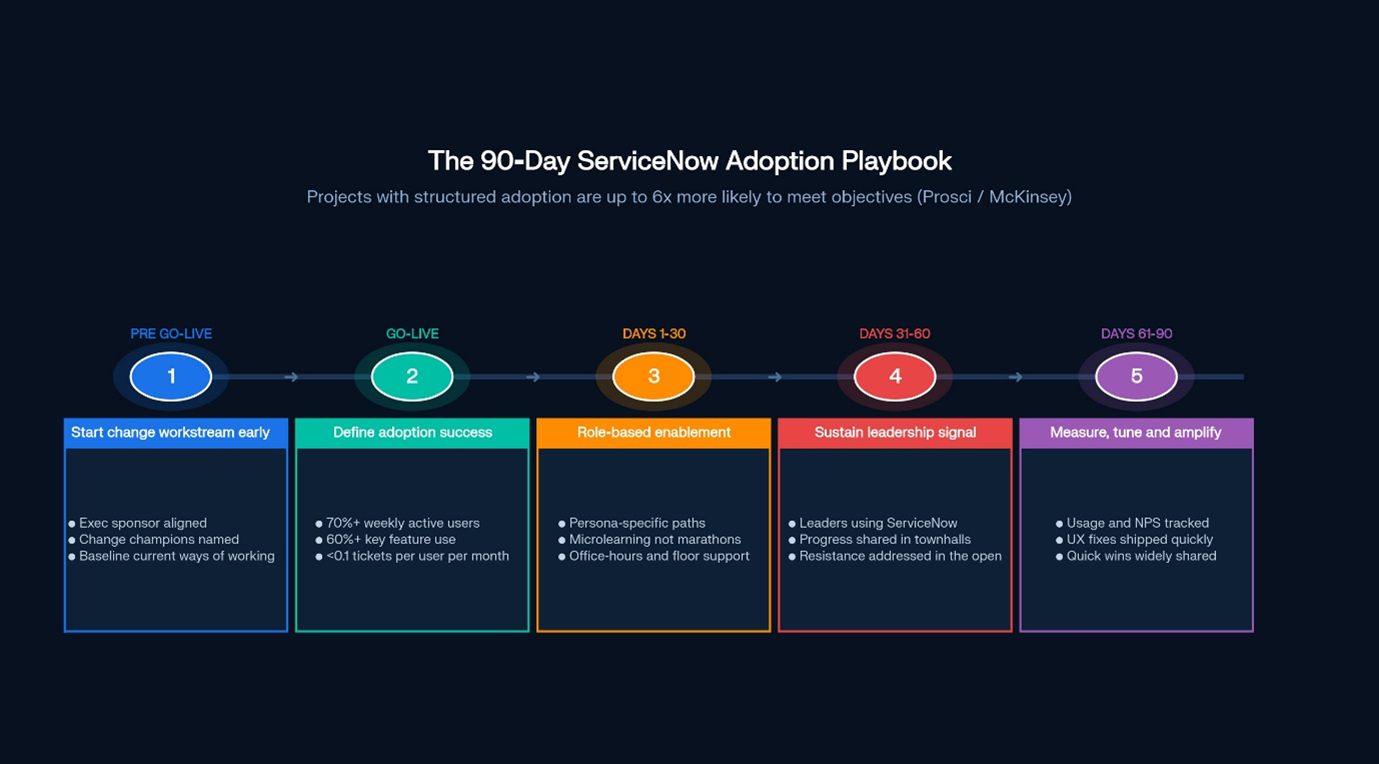
Start the change workstream at project kickoff, not at UAT. Align your executive sponsor, identify your departmental change champions, and baseline current process behaviors before a single workflow is configured.
-
Define what adoption success looks like. Industry benchmarks suggest targeting active weekly usage above 70%, feature utilization above 60%, and support tickets per user below 0.1 per month as leading indicators of a healthy deployment.
-
Build role-specific enablement, not generic training. Role-based microlearning accelerates upskilling by 42% compared to generic LMS sessions. Map each user persona to their specific workflows and build training around those scenarios.
-
Sustain executive visibility for at least 90 days post go-live. The adoption curve peaks and crashes fastest in this window. Visible leadership commitment is one of the highest-leverage interventions available.
-
Measure, adjust, and communicate wins early. Share quick wins internally. When users see that the platform is being watched, celebrated, and improved, resistance softens and peer adoption accelerates.
The Bottom Line
ServiceNow is an exceptional platform. The technology works. But technology creates potential. People turn that potential into performance.
For mid-sized enterprises especially, the organizations that will see genuine ROI from their ServiceNow investments in 2026 and beyond are the ones that invest in the human side of the deployment with the same rigor they apply to the technical side. That means strategy, structured enablement, sustained leadership, and a framework that addresses mindset, capability, and culture together.
The platform is ready. The question is whether your people are.
At Nihilent, our patented MC3® (MC Cube) framework addresses transformation across exactly these three dimensions: Mindset, Capability, and Culture. It is not change management as a checkbox. It is transformation engineering built for organizations that want to use ServiceNow, not just own it.
Most Read
May 28, 2019
Driving Operational Excellence Through Design Thinking
February 11, 2020
The Art of Data Science
June 12, 2019
Financial Inclusion through Digital Diversification