


The Real ROI of AI: Moving Beyond Cost Savings To Revenue Reimagination

By Rajeev Pandey, Principal Architect, Centre of Excellence-Data & Cloud
The Real ROI Of AI: Moving Beyond Cost Savings To Revenue Reimagination
I’ll be honest. When I sit in boardrooms and hear executives declare, “Our AI initiative saved us 15% in operational costs,” part of me wants to ask the obvious follow-up: And then what?
Don’t get me wrong – saving money matters. But if cost savings is where your enterprise’s AI story ends, you may have just spent three years and significant capital to become a slightly leaner version of exactly what you already were.
That isn’t transformation. That is simply optimization. And in today’s market, there is a massive, highly profitable difference between the two.
The Efficiency Trap
Most enterprises discovered AI through the back door: automating a support queue here, summarizing dense documents there, or shaving a few steps out of a legacy workflow. The savings were real, the deployment was fast, and the boards loved the numbers.
Consequently, a dangerous narrative calcified across the corporate world:
AI = Cost Reduction.
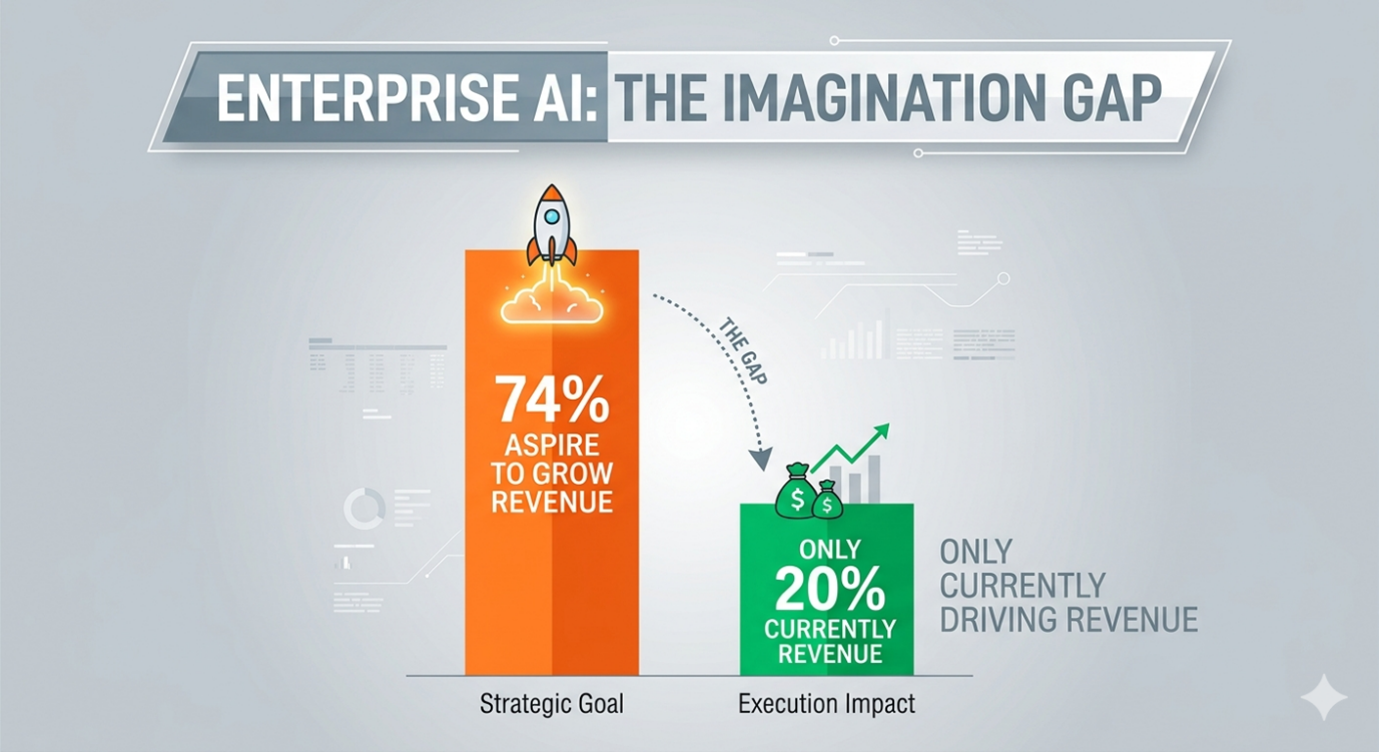
Here is the uncomfortable truth behind the data. A 2026 enterprise AI survey found that while two-thirds of organizations reported productivity and efficiency gains, a fraction are actually growing revenue through AI today – even though the vast majority aspire to.
That gap between aspiration and reality isn’t a technology problem. It’s an imagination problem. Most organizations are using AI to do old things faster. The ones pulling ahead are using it to do things they couldn’t do before.
What Revenue Reimagination Actually Looks Like
Let me make this concrete, because abstract strategy frameworks rarely change how people think in the real world.
Take a global retailer that recently used AI to build a real-time personalization engine. They didn’t just use it to recommend products. They used it to dynamically adjust pricing, optimize the exact timing of their outreach, and determine the specific channel a customer is most likely to convert through. The result? It wasn’t a line item on a cost sheet. It drove 38% of their revenue growth and shrank customer acquisition costs by nearly a fifth.
Or consider a hotel chain that deployed dynamic, AI-driven pricing that factored in live demand signals, local events, and even sudden weather shifts. Revenue per available room went up 22%.
That is new money, not saved money. These aren’t moonshot stories. They are simply what happens when a leadership team stops asking, “Where can AI cut costs?” and starts asking, “What could we offer – and who could we serve – if AI removed the constraints we’ve always worked around?“
Three Shifts That Separate Leaders from Laggards
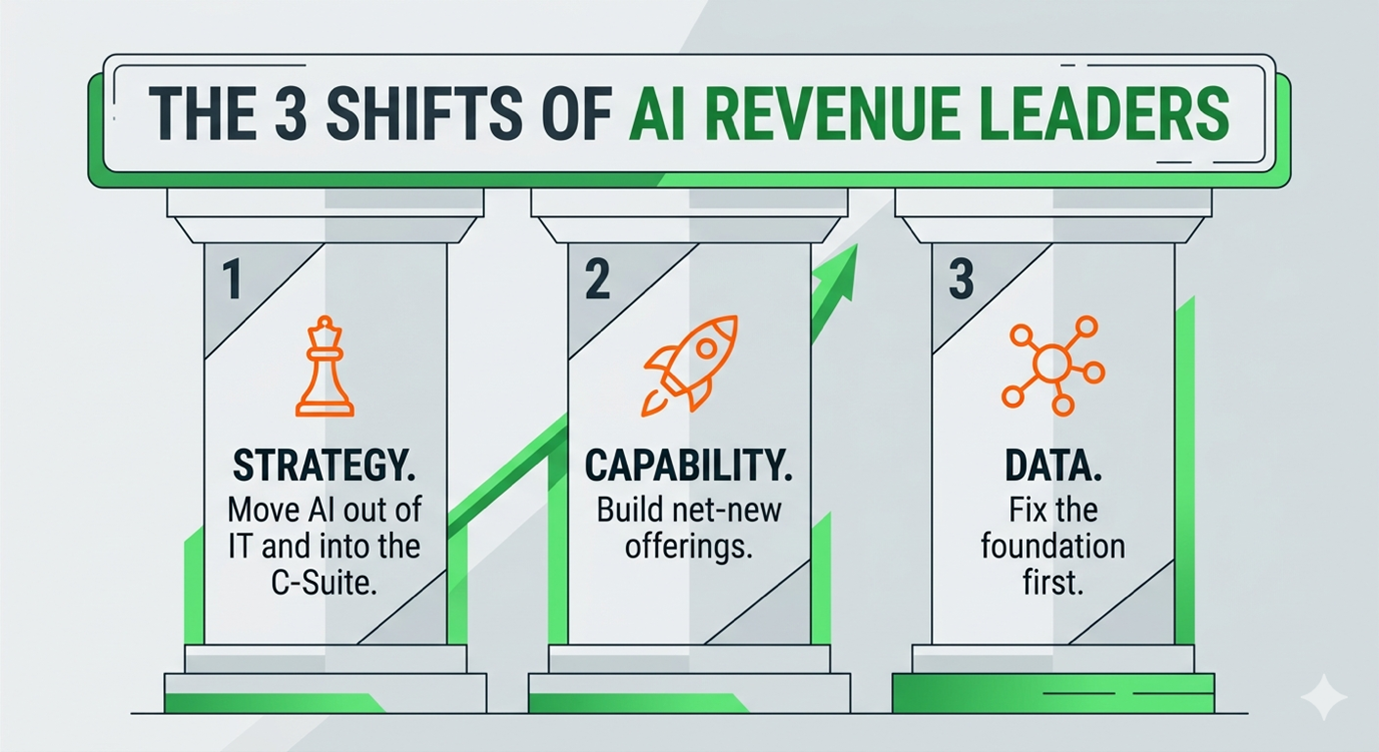
In my experience working across industries, the organizations making real, measurable revenue moves with AI share three distinct traits.
1. They made AI a revenue strategy, not an IT program.
The decisions aren’t being made in isolated technology committees; they are being driven by business leaders. A recent survey of Fortune 50–Global 2000 CXOs revealed that line-of-business leaders now wield equal or greater influence on AI adoption than CIOs and CTOs. The companies winning aren’t the ones with the largest parameter models. They are the ones where the CMO, the CSO, and the COO are actively shaping the AI agenda.
2. They invested in new capabilities, not just better versions of existing ones.
It is tempting to automate what already exists. The far more lucrative question is: What product could you launch, what customer segment could you serve, or what market could you enter if AI handled the complexity that previously made it impossible? The most exciting enterprise AI work happening right now involves companies building entirely new revenue streams they never could have staffed or scaled manually.
3. They got serious about data before they got serious about models.
This is less exciting to talk about, but it is exactly where most AI revenue ambitions quietly die. The number one blocker to scaling AI in the enterprise isn’t the technology – it’s fragmented, low-quality data. You can plug into the most powerful AI architecture in the world, but if your customer data is siloed across six legacy systems and nobody trusts it, you aren’t going to personalize anything. The “boring” work of data strategy is actually the most strategically critical work happening today.
The Question I’d Ask Every CXO
If your entire AI budget vanished tomorrow, would your competitors notice a difference in your revenue trajectory – or just in your cost structure?
If the honest answer is “just costs,” you are in the majority. But that will not be a safe place to stay. Enterprise AI spend has tripled in two years, crossing $37 billion in 2025 alone. The organizations making bold bets on AI-driven growth today are compounding advantages that will be genuinely hard to close in three years.
The window for treating AI strictly as a cost play is rapidly closing. What opens next is considerably more interesting – but also considerably more demanding. It requires business model thinking, not just technology thinking.
One Last Thought
The most dangerous AI ROI conversation isn’t the one where leaders ask the wrong questions. It is the one that doesn’t happen at all because everyone assumes someone else is already asking them.
-
If you are a CEO, ask your AI lead: What revenue is AI making possible that wasn’t possible before?
-
If you are a CEO, ask: What is the long-term cost of not reimagining our business?
-
And if you are a CISO or COO quietly cheering AI efficiency wins: Don’t stop. Just don’t stop there.
The real ROI of AI isn’t what it saves. It’s what it makes possible.
About the Author:
Rajeev Pandey leads the AI Centre of Excellence at Nihilent, helping organizations move from AI experimentation to measurable business impact.
Most Read
May 28, 2019
Driving Operational Excellence Through Design Thinking
February 11, 2020
The Art of Data Science
June 12, 2019
Financial Inclusion through Digital Diversification