


Beyond the Buzz: Why Semantic Layers Are Becoming the Infrastructure of AI and BI

By Prashant Pawar, Head Data and Cloud CoE, Nihilent Limited
Beyond the Buzz: Why Semantic Layers Are Becoming the Infrastructure of AI and BI
The surge in AI adoption has done something unexpected. It has brought semantic layers back to the centre of enterprise architecture conversations. What was once viewed as a BI modeling convenience is increasingly being recognized as foundational infrastructure. Gartner captured this shift sharply when it stated that by 2030, universal semantic layers will be treated as critical infrastructure, alongside data platforms and cybersecurity. That is not a prediction about the distant future. For organizations building AI strategies today, it is an immediate design imperative.
What is often misunderstood, however, is that semantic layers are not a single concept. They exist on a spectrum. At one end are lightweight SQL abstractions. At the other are fully governed, knowledge-driven data products that power both BI and AI at scale. Most organizations already sit somewhere on this spectrum, often without explicitly recognizing it.
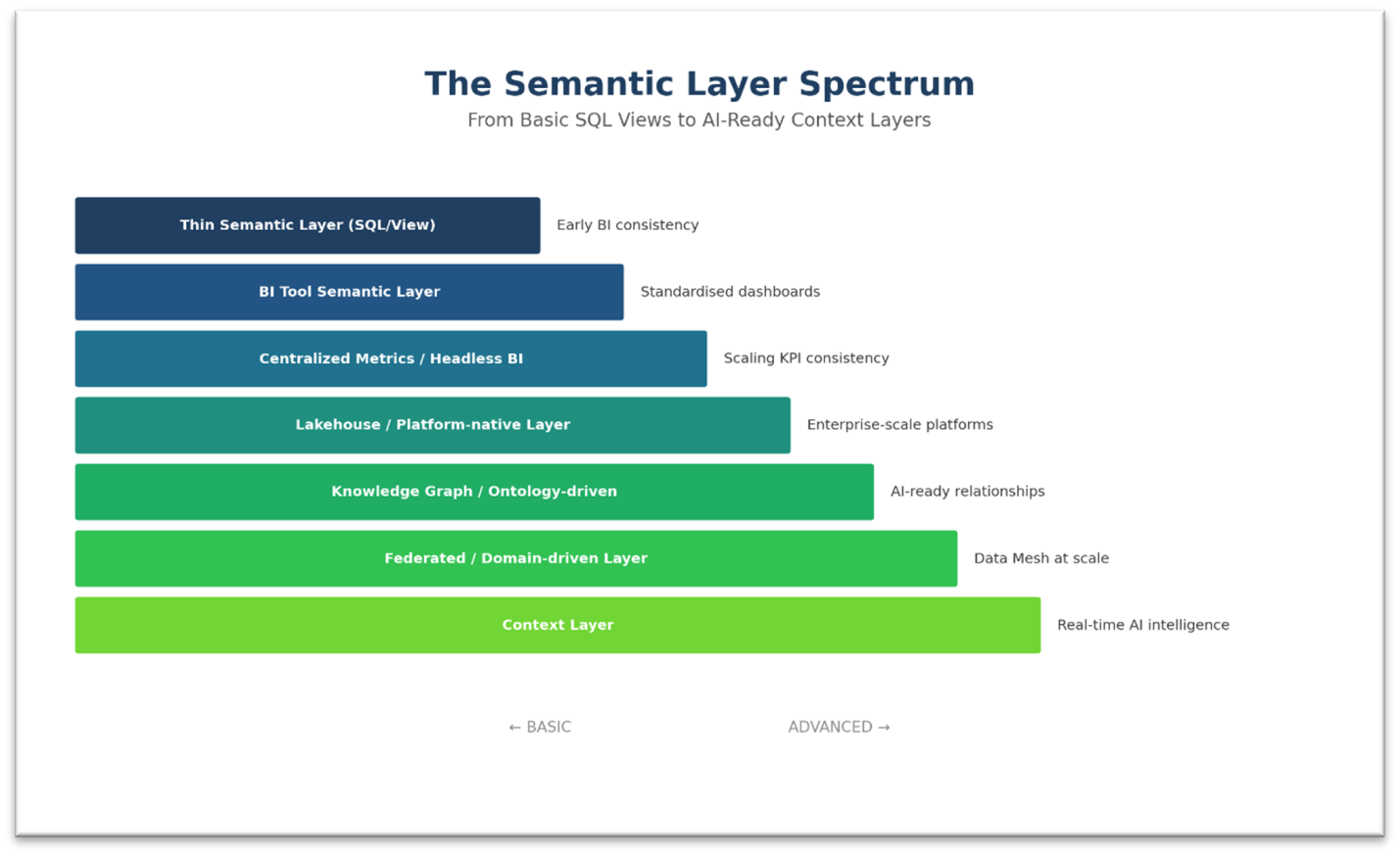
The progression from basic to advanced is not just a technical choice. It is a strategic one. A thin SQL or view-based layer works well for early BI, but creates logic duplication and weak governance as the organization scales. BI tool semantic layers standardize dashboards, but trap business logic inside a single platform. Centralized metrics and headless BI approaches improve KPI consistency, yet remain primarily metric-centric. Lakehouse and platform-native layers strengthen enterprise scale, but introduce dependency on a specific vendor. At the advanced end, ontology-driven and knowledge graph approaches deliver richer AI readiness, while federated domain-driven layers support Data Mesh at scale. The context layer, the most recent addition to this stack, adds real-time situational awareness and user intent to power adaptive AI experiences.
The important insight is that organizations do not need to leap from SQL views straight into complex ontologies. Doing so prematurely introduces unnecessary complexity and delays value realization. The smarter approach is to treat semantic layers as an evolutionary journey with deliberate, phased progression.
The Shift: From Metrics to Meaning
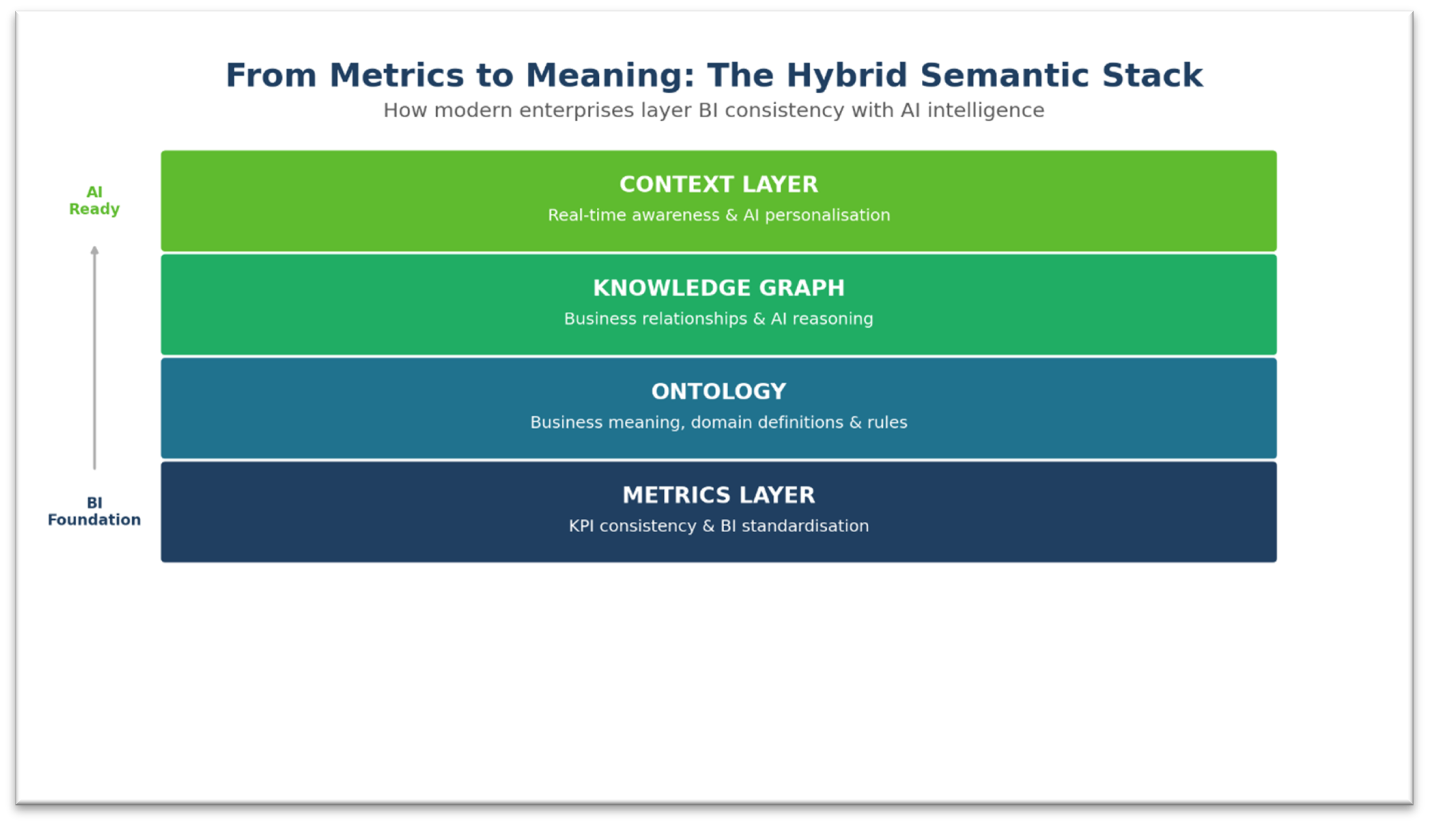
What is driving this evolution is a fundamental change in what AI and BI systems are being asked to do. Metrics answer what happened. Meaning explains why it happened, how it connects to other business entities, and what action should follow. The future architecture is not a single layer replacing another. It is a hybrid stack: a metrics layer for BI consistency, an ontology for business meaning, a knowledge graph for entity relationships, and a context layer for real-time intelligence.
This is where the market is heading. In the Forrester BI Platforms Wave of 2025, the ability to expose consistent business semantics across both analytical and AI use cases emerged as a key differentiator. The organizations pulling ahead are those who invest in the knowledge layer beneath the AI experience, not just the experience itself
Choosing the Right Starting Point
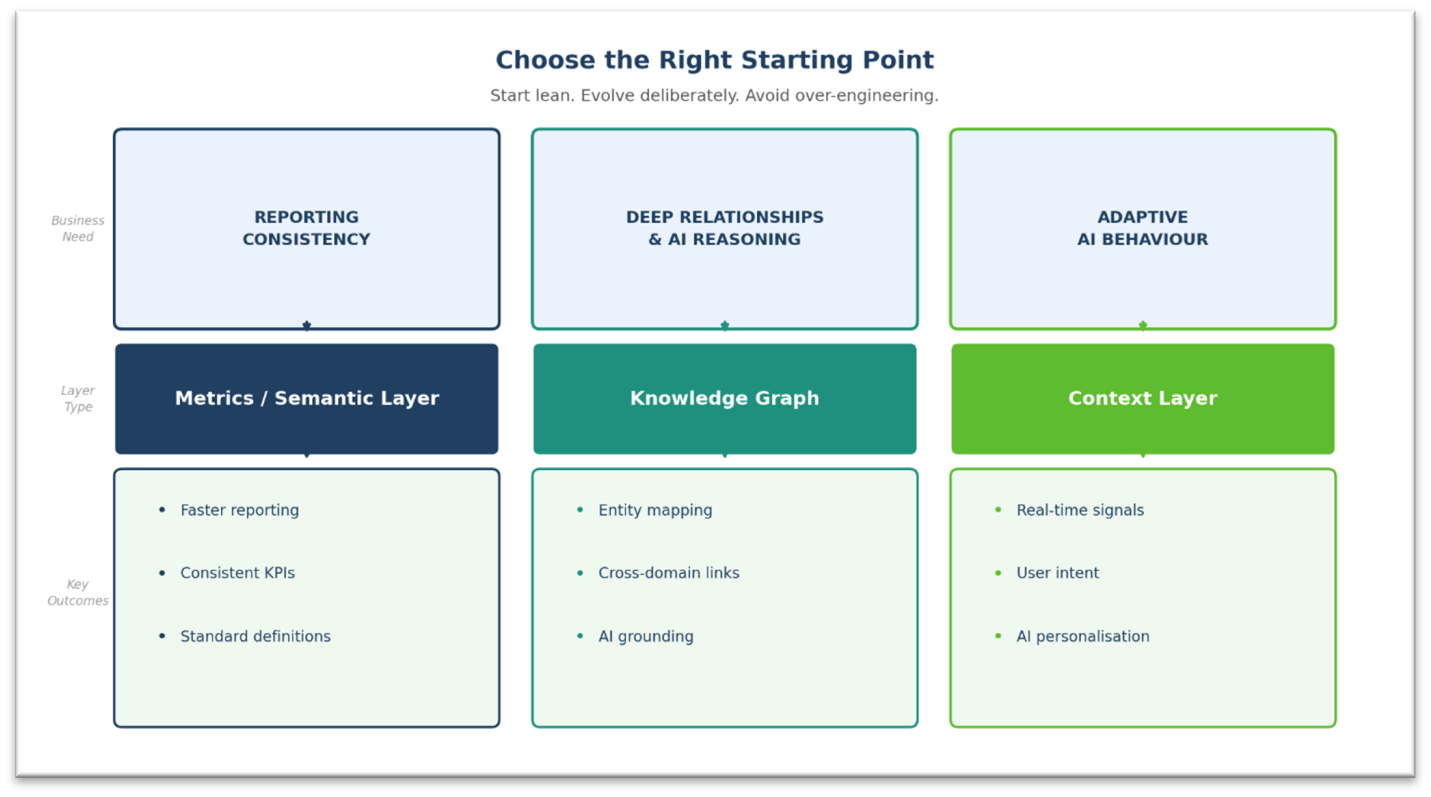
The most common mistake is over-engineering from day one. The right starting point depends entirely on the primary business need.
If the immediate need is reporting consistency and KPI standardization, start with a metrics or semantic layer. It delivers faster time-to-value without premature complexity. If the business requires deep relationships and AI reasoning across domains, a knowledge graph is the right investment. If the goal is adaptive, AI-driven systems that respond to user intent and real-time signals, the context layer becomes relevant.
Higher complexity always comes at a cost: higher implementation time, greater governance burden, and slower ROI. A phased approach that starts lean and evolves deliberately is almost always the right call.
The enterprises that will lead in AI are not necessarily the ones with the most sophisticated architectures today. They are the ones who understand where they are on the semantic spectrum, make deliberate choices about where to invest next, and build a knowledge foundation that makes both their BI and AI trustworthy, consistent, and scalable.
Semantics is no longer a data modeling concern. It is a business strategy decision.
About Prashant Pawar
Prashant Pawar is Head of Data and Cloud CoE and Data Strategy & Analytics Practice Leader at Nihilent. He helps enterprises strengthen their data and cloud foundations to enable smarter decisions, scalable innovation, and measurable business value. His work focuses on translating emerging technologies into practical outcomes across data, analytics, and cloud transformation.
Most Read
May 28, 2019
Driving Operational Excellence Through Design Thinking
February 11, 2020
The Art of Data Science
June 12, 2019
Financial Inclusion through Digital Diversification