


AI In The Mid‑Market: From Noise To Non‑Negotiable Value

By Sanjeev Singh, Vice President & Practice Head – ServiceNow, Salesforce and Testing, Nihilent Limited
AI In The Mid-Market: From Noise To Non-Negotiable Value
Artificial intelligence is now a boardroom topic in every sector. Mid‑sized enterprises are not asking whether to adopt AI. The question is how to do it in a way that creates visible value without distracting the business or increasing risk.
Global research is clear. McKinsey estimates that AI, especially generative AI, could add between 2.6 and 4.4 trillion dollars annually to the global economy, with most of the value in customer operations, marketing and sales, software engineering, and R&D. Forrester finds that small and mid‑market businesses in APAC using AI are 20 percent more likely to report significant revenue growth than peers that are not. Yet other studies show AI maturity is actually slipping even as adoption rises, because many organizations are deploying AI faster than they can govern or scale it.
For a mid‑sized enterprise, this combination of pressure and uncertainty is dangerous. You cannot afford to sit out the AI wave. You also cannot afford vanity projects that never leave the lab. What you need is a practical path that connects AI to your strategy, fixes your fundamentals, and delivers outcomes in months, not years.
Below are seven business truths about AI, grounded in current research, followed by a focused playbook for mid-sized enterprises.
Truth 1: AI is not your strategy. It is a force multiplier for a real plan.
Many boards begin with the question, “What is our AI strategy?” That is the wrong starting point. Your strategy is still about growth, profitability, risk, and customer experience. AI is a powerful way to execute that strategy faster and better.
Research backs this up. In McKinsey’s work on generative AI, about 75 percent of the value pools sit in very specific business functions: customer operations, marketing and sales, software engineering, and R&D. In other words, value comes when AI is embedded into real workflows, not when it sits in an innovation lab.
Mid-sized enterprises that lead with “we need an AI program” often end up with disconnected pilots, unclear ownership, and no measurable ROI. Mid-sized enterprises that start with “we need to reduce ticket backlog by 30 percent, or cut days-sales-outstanding by five days” are the ones that actually capture value.
Leadership direction:
-
Start from three to five strategic outcomes you already care about.
-
Ask where decisions are slow, processes are manual, or experiences are inconsistent.
-
Only then ask, “Where can AI change this equation in a way normal automation cannot?”
Truth 2: The mid-market is already moving. Standing still is now the risky choice.
The idea that AI is only for large enterprises is out of date.
-
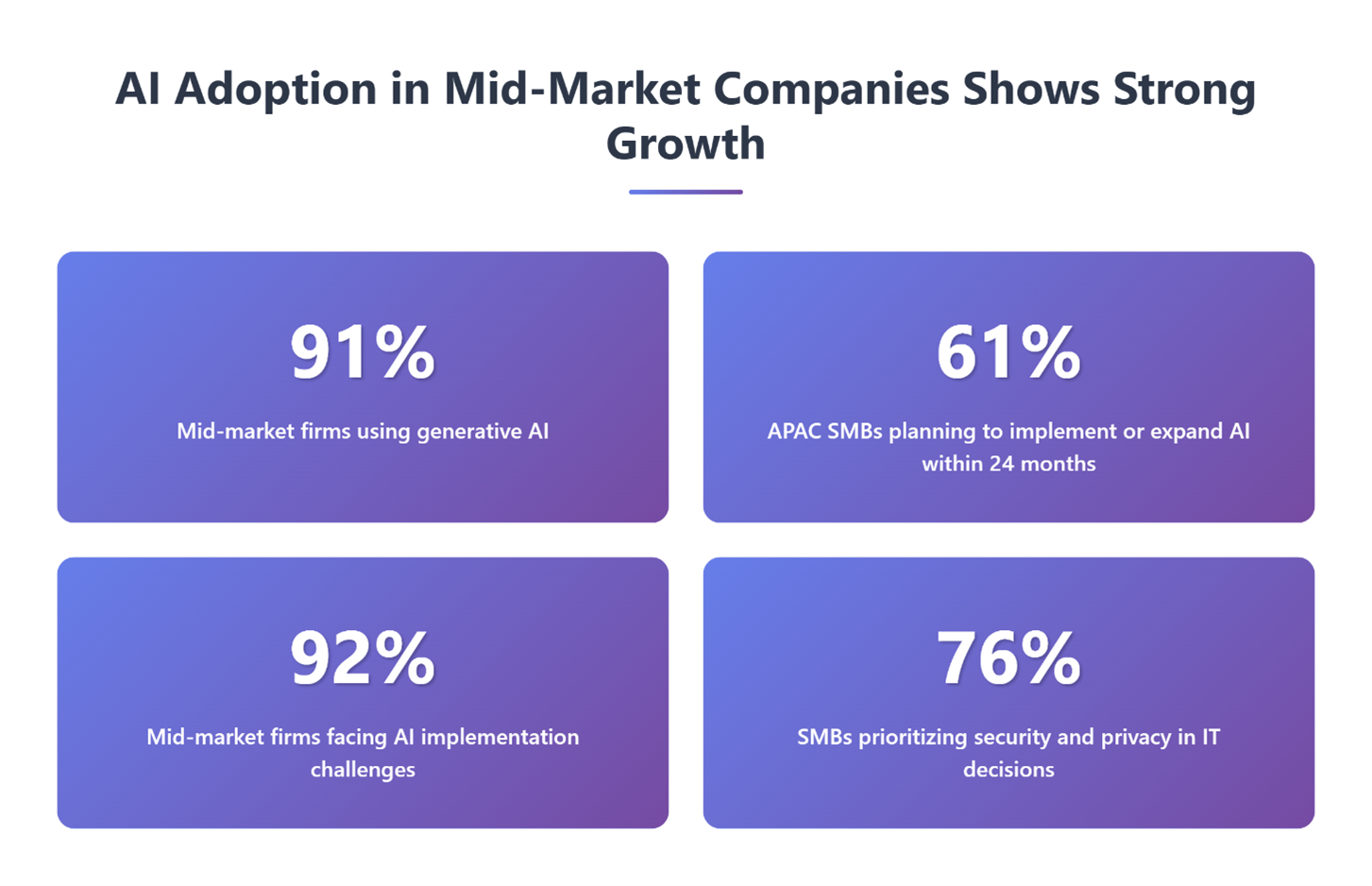
Forrester’s recent study of SMBs in APAC found that 61 percent plan to implement or expand AI within 24 months, and those using AI are significantly more likely to report strong revenue growth
-
Techaisle’s global research with 2,100 SMB and mid-market decision makers shows AI investments are now seen as strategically important across the 1 to 4,999 employee segment, with adoption spreading across customer service, analytics, operations, and back-office functions
-
RSM’s 2025 Middle Market AI Survey found that 91 percent of mid-market firms in the US and Canada are already using generative AI, and 79 percent of those have a defined adoption strategy or roadmap
The message is clear. Your peers are already experimenting, learning, and institutionalizing AI. The risk is no longer being an early adopter. The risk is explaining to your board, three years from now, why your cost base, customer NPS, and cycle times look structurally worse than competitors who re‑engineered their work with AI.
Leadership direction:
-
Benchmark your AI activity against similar-sized peers, not against tech giants.
-
Treat AI as a competitiveness topic in your three-year plan, not as a side project in IT.
Truth 3: Value hides in a handful of practical use cases, not in a thousand pilots.
Global consulting research converges on the same pattern. The bulk of AI value comes from a surprisingly short list of use cases. In customer engagement and service, McKinsey has documented productivity improvements of up to 45 percent in customer care when AI assistants support agents in real time. In software development, generative AI can accelerate coding, testing, and documentation. In sales and marketing, AI can personalize outreach at scale.
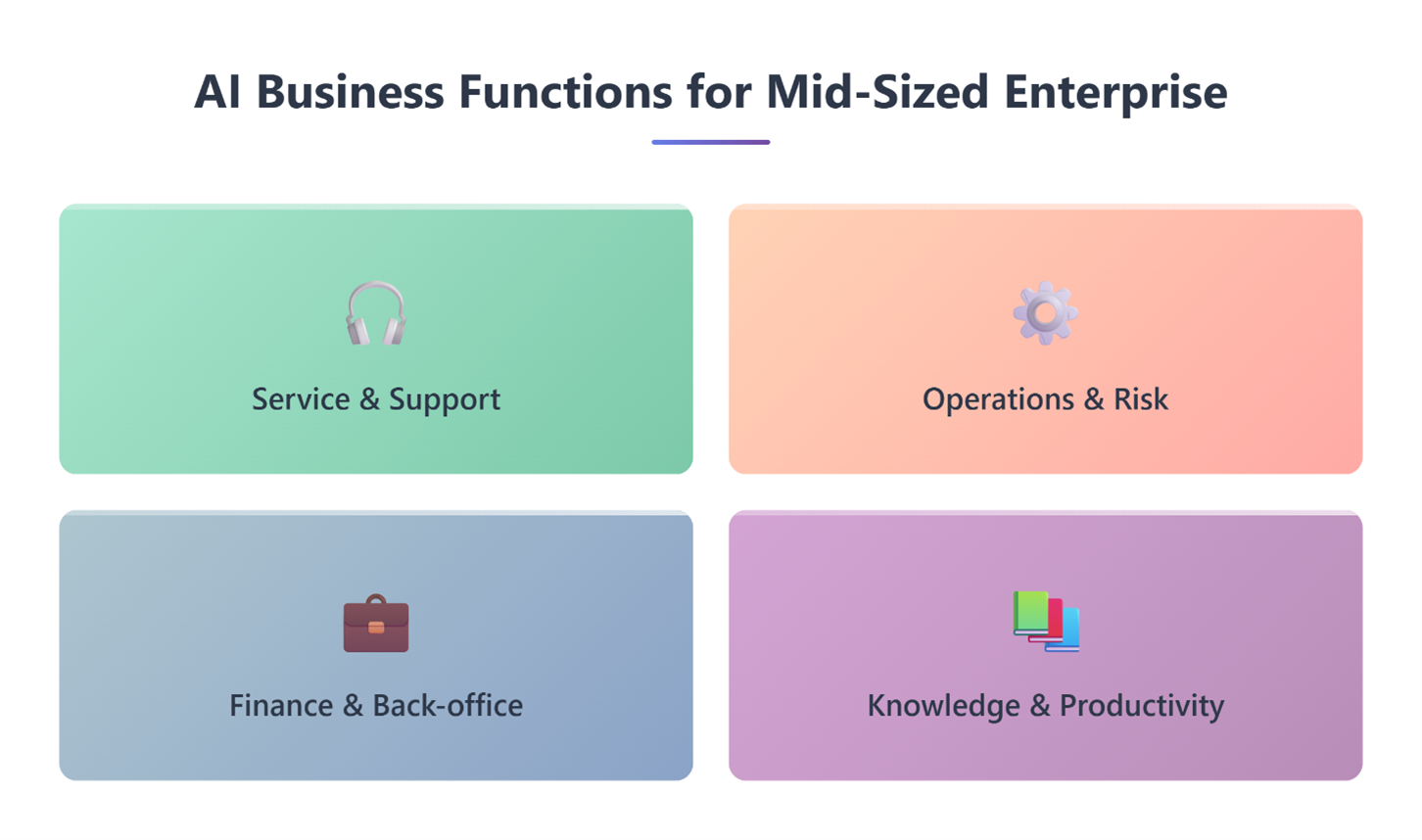
For mid-sized enterprises, the winning use cases are usually not exotic. They are close to the core:
-
Customer and employee service
-
AI-assisted virtual agents and agent-assist for IT, HR, and customer service
-
Intelligent routing, summarization, and knowledge suggestions inside existing ticketing and case systems
-
-
Operations and risk
-
Predictive alerts for incidents, outages, and SLA breaches
-
Anomaly detection in finance, procurement, or security data
-
AI-assisted risk and compliance workflows that turn policies into operational checks
-
-
Knowledge and productivity
-
Enterprise search that surfaces the right document, answer, or runbook in natural language
-
AI copilots embedded into platforms your teams already use for work
-
McKinsey estimates that, globally, generative AI could boost labor productivity by about 0.7 percent per year through 2040, largely through these kinds of embedded use cases.
Leadership direction:
-
Choose three high-value, repeatable use cases that live inside existing processes.
-
Design them to show results in 90 days, with clear “before vs after” metrics.
-
Resist the temptation to launch ten pilots at once. Depth beats breadth.
Truth 4: Data and process readiness matter more than model sophistication.
Most mid-market AI frustrations have nothing to do with the model and everything to do with the data and process behind it.
Techaisle’s SMB and mid-market research highlights data quality, integration, and fragmentation as top barriers to effective AI, alongside talent gaps. Forrester’s SMB study in APAC found that lack of AI knowledge, insufficient technical skills, and employee readiness were among the most cited obstacles, even as firms increased spending. RSM’s middle market survey reports that 92 percent of firms using generative AI face implementation challenges, with data quality, skills, and governance at the top of the list.
If your incident data is inconsistent, your HR cases are logged in free text, and your customer records are split across four systems, a cutting-edge model will simply produce faster confusion.
Leadership direction:
-
Treat a basic data foundation as part of your AI program, not a separate IT project.
-
Standardize how you capture service tickets, HR cases, and customer interactions.
-
Invest in data governance and literacy for business teams, not just data scientists.
Truth 5: Big-bang AI transformations rarely work. Start small, deliver fast, scale what works
Every major study of AI adoption tells the same story. Ambitious, multi-year, enterprise-wide AI programs look impressive on slides but struggle in reality, especially for mid-sized organizations with lean teams.
At the same time, there is growing evidence that incremental programs can deliver outsized returns. The Forrester study of APAC SMBs shows that firms are shifting spend toward partners who help them implement targeted AI in the cloud, link it to workflows, and scale it. RSM’s survey found that 70 percent of middle market firms using generative AI believe they need external partners to unlock full value, and nearly half of their dedicated AI budgets already flow to consulting and implementation services.
The most successful organizations follow a pattern:
-
Pick one or two concrete problems.
-
Build, test, and refine in a contained environment.
-
Prove value, codify a pattern, and then scale it across functions and regions.
This is exactly what many CIOs and IT leaders ask for: practical next steps, explainable AI, simple governance, and early value they can show to business stakeholders.
Leadership direction:
-
Declare that your AI program will be “start small, deliver fast, scale what works”.
-
Avoid multi-year roadmaps without near-term milestones.
-
Tie funding to proof points from pilots, not to generic AI “transformation” budgets.
Truth 6: Governance, risk, and ethics are now central to AI, not optional extras.
With regulators active and customers more sensitive to data privacy, AI can no longer be treated as a purely technical concern. Poorly governed AI can introduce bias, leak sensitive information, or create opaque decisions that your teams cannot explain.
Consulting and risk research consistently underline the need for integrated risk and compliance frameworks that connect AI initiatives with existing controls, security operations, and governance, rather than bolting AI on the side.
Middle market surveys echo this. In the Forrester APAC SMB study, 76 percent of respondents identified security and privacy improvement as their top IT priority, above traditional cloud migration. RSM’s findings show that, even among firms reporting positive AI impact, governance and risk remain major sources of concern.
Leadership direction:
-
Establish an AI use policy that covers data usage, privacy, transparency, and human oversight.
-
Ensure every AI use case has an identified process owner, risk owner, and escalation path.
-
Integrate AI risk into your existing risk and compliance processes rather than inventing a parallel system.
Truth 7: Mid-sized enterprises win when they combine people, platforms, and partners.
The final truth is simple. AI is not a silver bullet, and it is not a toy. It is a new way of working that blends human judgment with intelligent platforms. Research across SMB and mid-market segments shows that organizations increasingly lean on external partners for AI strategy, implementation, and ongoing support, precisely because the skills and integration demands cut across IT, operations, and risk.
Mid-sized enterprises have a structural advantage here. You are large enough to fund meaningful programs, but small enough to align stakeholders quickly. When leadership, business owners, IT, and external partners work as one team, AI moves from hype to habit.
Leadership direction:
-
Make AI a cross-functional responsibility, not just an IT experiment.
-
Pair internal process owners with external experts who have seen what “good” looks like in similar environments.
-
Focus on explainable, human-centered AI that teams can understand and trust.
A Practical AI Playbook For Mid-Sized Enterprises (First 12 Months)
Theory does not impress your board or your teams. Outcomes do. The following roadmap is designed for enterprises in the 500 to 5,000 employee range that want to move from exploration to execution without losing control.
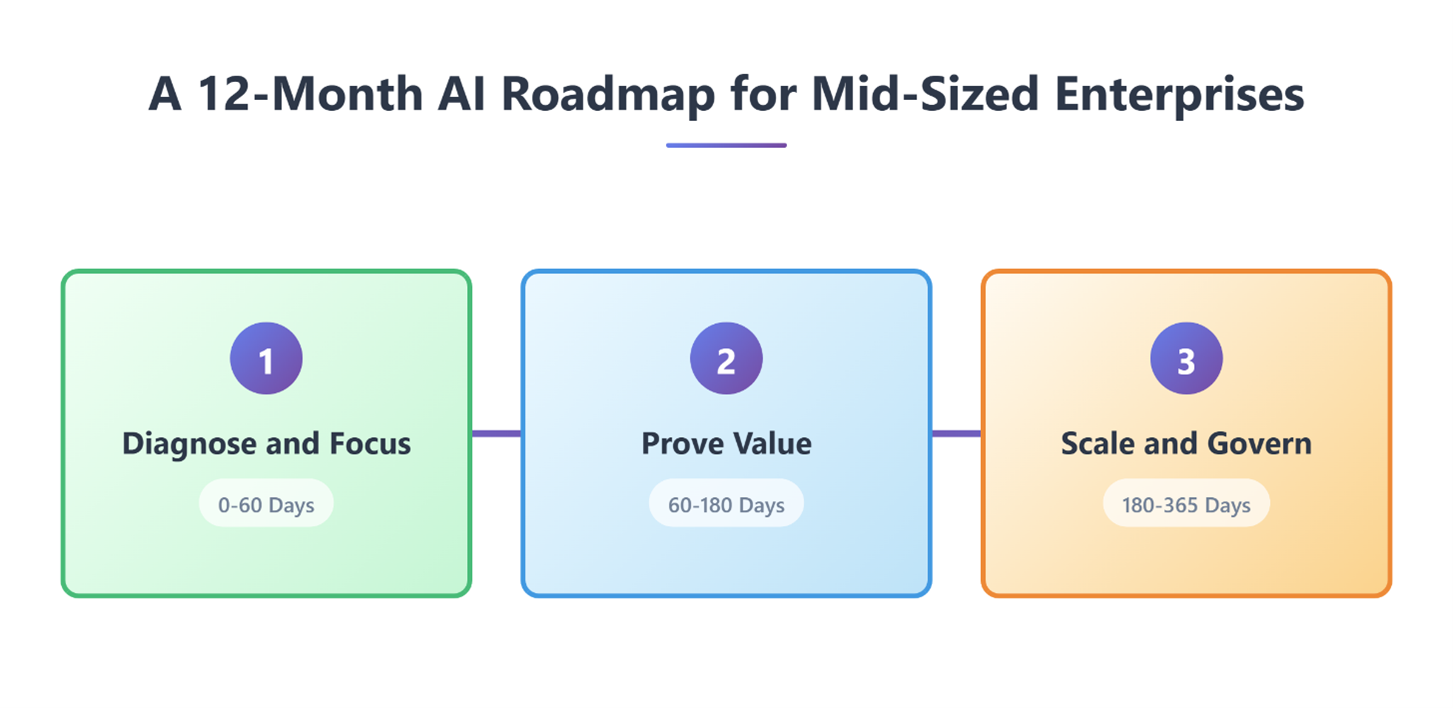
Phase 1: Diagnose and focus (0 to 60 days)
-
Clarify your AI ambition in business terms
-
Agree three to five measurable outcomes: for example, reduce average resolution time by 30 percent, cut onboarding turnaround time by 40 percent, or automate 25 percent of low-value back-office tasks.
-
-
Map your AI-ready workflows
-
Identify high volume, rules-heavy processes across IT service, HR, customer service, finance, and risk.
-
Look for areas where workers spend significant time searching for information, switching systems, or performing repetitive triage.
-
-
Assess data, platforms, and skills
-
Run a quick assessment of data quality, process standardization, and existing workflow platforms.
-
Identify skills and capacity gaps. Use external benchmarks and research on SMB and mid-market AI adoption to calibrate where you stand.
-
Phase 2: Prove value with two flagship use cases (60 to 180 days)
Choose one use case in service (IT or customer) and one in back-office or risk. For each:
-
Design with the end user in mind.
-
Engage agents, HR partners, finance teams, or analysts in the design.
-
Keep the initial solution simple: AI assisting humans, not replacing them.
-
-
Embed AI into systems people already use.
-
Integrate virtual agents, AI assistants, summarization, and recommendations into existing workflow platforms rather than building standalone tools.
-
Ensure every AI interaction is logged, explainable, and auditable.
-
-
Measure rigorously
-
Define baseline and target KPIs: handling time, backlog, first contact resolution, NPS, employee satisfaction, and error rates.
-
Report progress monthly to the executive team with simple visuals that compare before and after.
-
If a use case does not move the needle within 90 days, fix it or stop it. Momentum matters
Phase 3: Scale what works and strengthen governance (180 to 365 days)
Once you have two successful patterns:
-
Scale horizontally
-
Replicate the proven pattern across business units, regions, or adjacent processes.
-
Build reusable components, templates, and guardrails so each new deployment takes less time and risk
-
-
Institutionalize governance
-
Formalize an AI review process that evaluates new ideas against strategy, risk appetite, and technical fit.
-
Align AI with your risk and compliance frameworks, including policies, training, and reporting.
-
-
Invest in people and culture
-
Launch targeted training so employees understand how to work with AI, not fear it.
-
Highlight internal success stories where AI freed people from low-value tasks and improved outcomes.
-
By the end of year one, your goal should not be “we have AI everywhere.” Your goal should be “we have three to five AI-enabled workflows delivering measurable value, a playbook to scale them, and governance that lets us go faster safely.”
AI will not win the race for you on its own. The enterprises that pull ahead will be those that treat AI as a disciplined way to solve real problems, not as a branding exercise. For mid-sized organizations, the opportunity is especially strong. With the right focus, partners, and governance, you can move faster than larger competitors and turn AI from a buzzword into a quiet, everyday engine of value.
Most Read
May 28, 2019
Driving Operational Excellence Through Design Thinking
February 11, 2020
The Art of Data Science
June 12, 2019
Financial Inclusion through Digital Diversification